
What Urban History Can Teach Us About the Future
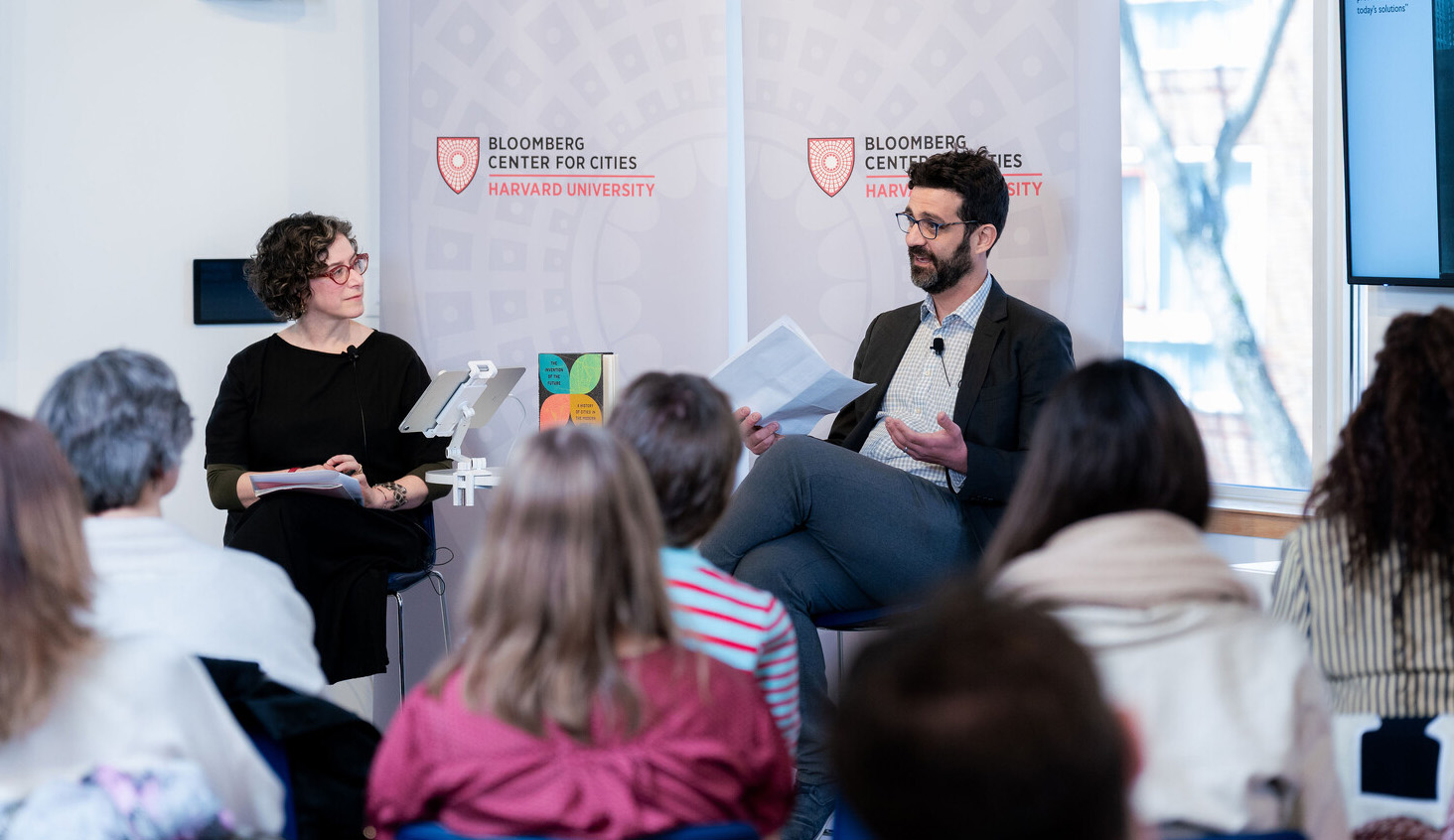
Cambridge, Massachusetts (April 27, 2026)—At a conversation hosted by the Bloomberg Center for Cities at Harvard University, Bruno Carvalho, Professor of Romance Languages and Literatures and of African and African American Studies in the Harvard Faculty of Arts and Sciences, argued that cities are shaped by people trying to invent the future—but that the most useful lesson of urban history may be how to plan with greater humility, flexibility, and openness to outcomes no one can fully foresee.
The April 9 discussion drew on Carvalho’s latest book, “The Invention of the Future: A History of Cities in the Modern World,” and featured Rachel Weber, Emma Bloomberg Professor of Urban Planning and Chair of the Department of Urban Planning and Design at the Harvard Graduate School of Design, as interlocutor. Together, the two Bloomberg Center for Cities faculty affiliates explored what three centuries of city-making can teach planners and policymakers confronting rapid urban change today.
In eighteenth-century Europe, Carvalho explained, people began to imagine the future as something humans could build, rather than something divinely ordained. Modern cities became one of the clearest expressions of that shift. His research traces that story through Lisbon, New York, Paris, Rio de Janeiro, Buenos Aires, Brasília, Lagos, and East Asia. However, he warned urban history is full of turns that would once have seemed implausible. “Reasonable expectations underestimate the range of potential outcomes,” he said.
Avoiding Unintended Consequences
Carvalho defended expertise and planning but pushed back against overconfidence in prediction. Forecasts do not simply describe the future; they can justify investments, provoke backlash, and help shape outcomes themselves. He shared a history of unintended consequences: boulevards opened to suppress revolt became sites of larger uprisings, cars solved one set of problems before generating others, participatory planning emerged as a democratic corrective only to be used in some contexts to block housing and entrench incumbent interests.
Using History Wisely
Weber asked what role history should play in contemporary planning. Carvalho’s answer was not to reject modeling or data, but to place them in a wider frame. Cities work best, he said, when they remain open to futures no one can fully control. Planning should focus on meeting basic needs—housing, water, transit-rich and compact living—while remaining wary of rigid prescriptions and claims of certainty.
Weber pressed Carvalho on whether planning schools should still teach projections, predictive analytics, and long-range modeling if urban history is full of failed forecasts. Carvalho’s answer was a qualified yes. Predictive tools, he said, are indispensable and far more sophisticated than they once were. But they still begin with what is already known. Data can illuminate probabilities; it cannot eliminate uncertainty. The goal, he suggested, is to use models seriously without mistaking them for destiny.
Imagining Urban Futures – Boldly but with Humility
Carvalho also made a case for compact urban design as a practical matter of land use, energy use, mobility, and choice. In many American jurisdictions, he noted, it remains effectively illegal to build walkable, transit-rich environments. More broadly, he argued that planners have become adept at defending efficiency and optimization, but less skilled at defending the forms of urban life that make cities meaningful, not just productive.
The event, rather than defending any single planning doctrine, made the case for a different posture toward urban futures. Carvalho’s argument was not that cities should stop imagining boldly. It was that they should do so without assuming that the future can ever be fully forecasted, fixed, or mastered.
Resource: Are Your City’s Policies as Dynamic as Your Residents’ Preferences?
Amenity clusters—main streets, business districts, and other commercial and cultural corridors—are centers of city life. But as visitation preferences shift over time, what policy interventions can keep these locations relevant to residents? Explore research about where to exercise control, when to change tactics, and what the future may hold.More about Bruno Carvalho and his work
Visit Carvalho’s webpage to learn more about his work on urban life and how cities change.Video: Inventing Urban Futures: Lessons from Three Centuries of City-making
Watch the recorded presentation with Bruno Carvalho and Rachel Meltzer.Event recap: An Analytical Framework Brings Clarity to Public Problem-Solving
A 2025 conversation with Rachel Meltzer at the Bloomberg Center for Cities at Harvard University explored how city leaders can navigate tough, evolving challenges effectively by expanding the evidence base they bring to high-stakes policy decisions.