
Disagreeing Better as a Leadership Practice
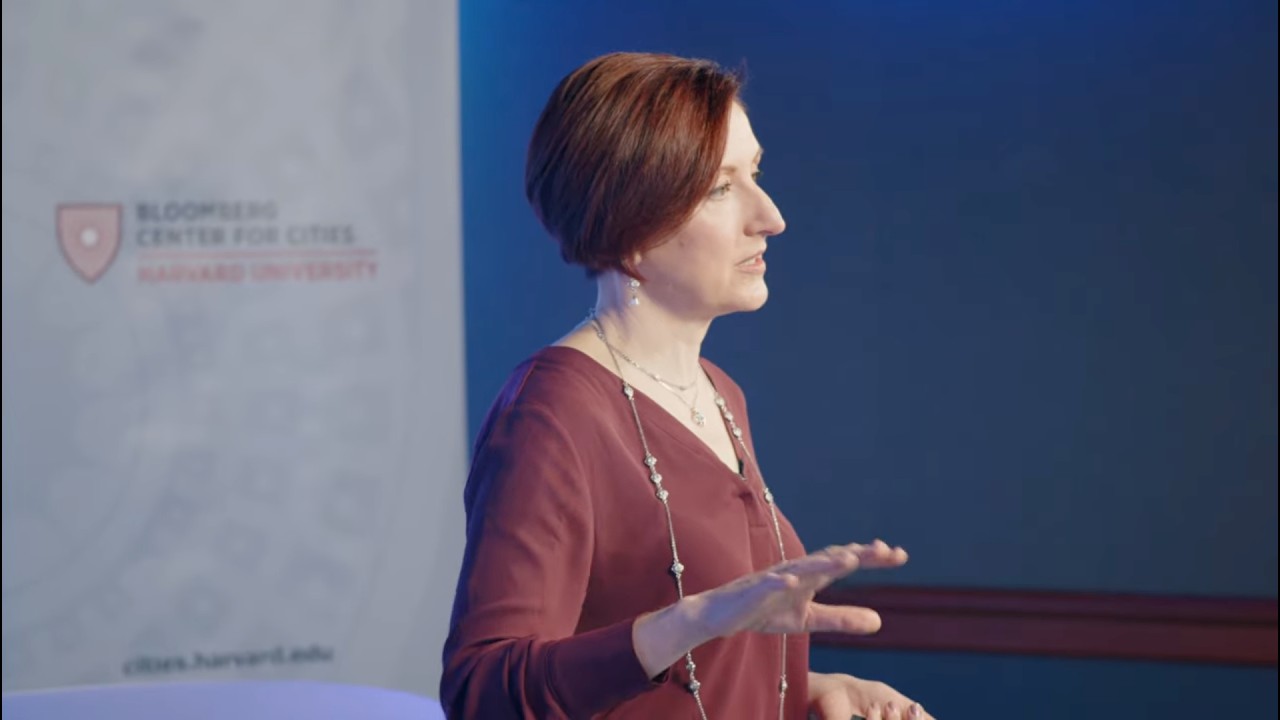
Cambridge, Massachusetts (April 21, 2026)—At a virtual workshop hosted by the Bloomberg Center for Cities, Harvard Kennedy School professor and Center faculty affiliate Julia Minson invited current and aspiring public leaders to see disagreement not as a threat to leadership, but as one of its central clarifying tools. Drawing on behavioral science research from her new book, “How to Disagree Better,” Minson explained that leaders in public life need more than strong convictions: they also need the ability to help others feel heard, especially in moments of tension. For those working in cities, agencies, and community-facing roles, she suggested, these skills can strengthen relationships, improve decision-making, and make disagreement productive rather than corrosive.
Disagreement is Necessary
Presenting on Disagreeing Better: Research-backed Tools for Navigating Conflict, Minson began by underscoring how pervasive disagreement is in civic and organizational life. It arises within teams, across agencies, in interactions with residents, and in broader public debates. And while disagreement can be uncomfortable, she argued that it is also necessary. Leaders who can engage opposing perspectives effectively are better positioned to make sound decisions, avoid errors, and respond thoughtfully to complex problems.
Still, many people avoid disagreement altogether, especially when issues feel emotionally charged or morally fraught. Recent years, Minson noted, have offered no shortage of examples of conversations that quickly become too painful or polarizing to sustain. The challenge, she said, is not only to navigate today’s divisions, but to develop tools for “whatever the next thing is that we can’t disagree about.”
Encouraging Receptiveness
A central concept in the workshop was receptiveness, which Minson defined as a willingness to access, consider, and evaluate opposing views in a relatively impartial way. She was careful to distinguish this from compromise or surrendering one’s beliefs. Receptiveness, as she described it, is about thinking harder, not caving in.
It matters because receptiveness delivers both decision-making and interpersonal benefits. People who are more receptive, Minson said, are better at taking in information they may disagree with, paying attention to it, and evaluating it more fairly. They are also more likely to build relationships across difference, to be seen as collaborative and trustworthy, and to experience less emotional strain during conflict.
Gaps Between Intention and Impact
One of the session’s practical insights was that feeling receptive internally is not enough. Because disagreement is interpersonal, what matters is whether another person can perceive that openness. Minson described this as a kind of “leaky pipeline”: a person may enter a conversation with good intentions, only to have those intentions diluted by stress, emotion, body language, or tone. The other person, already anticipating conflict, may misread the interaction entirely.
That is why, Minson argued, leaders should focus less on private feelings and more on visible behavior—especially language. Her research has found that certain words and phrases make people feel heard during disagreement and are associated with better conflict outcomes.
The H.E.A.R. Framework
To make helpful behaviors easier to practice, Minson introduced the H.E.A.R. framework:
- H stands for hedging claims, using phrases like “I think” or “it’s possible” to leave room for another perspective.
- E stands for emphasizing agreement, identifying a shared goal or value before moving into contentious waters.
- A represents acknowledging the other perspective, showing that you understood what the other person said rather than merely asserting that you listened.
- R stands for reframing to the positive, replacing escalating language with wording that keeps the conversation constructive.
The framework, Minson emphasized, is not about being vague or withholding disagreement. It is about expressing one’s position in ways that make continued dialogue more likely.
Putting Lessons into Practice
The workshop’s interactive format reinforced that message. In breakout rooms, event participants met one-on-one to brainstorm strategies for demonstrating receptiveness. They surfaced ideas such as active listening, asking curious questions, repeating back what someone has said, and using attentive body language. Minson addressed audience questions from how to work effectively with agitated residents in public meetings to whether receptiveness has limits when confronted with racist or intolerant speech.
Minson acknowledged both the promise and the limits of the approach. Receptiveness takes time, and it does not mean tolerating everything. But as a leadership practice, she noted, it offers a path for making difficult conversations highly informative, less reactive, and more generative. For public leaders, that was the session’s clearest takeaway: disagreement is not a distraction from leadership. Done well, it can be an engine, not an enemy, of effective leadership.
Key Takeaways
Resource: When Innovation Causes Conflict: Ostrich, Chameleon, and Dolphin Strategies in the Public Sector
Innovation often involves disputes over what is most important. All too frequently, these “value conflicts” can undermine or even derail a new policy, tool, program, or process public sector leaders seek to implement. Explore research about how to overcome these obstacles.Book: How to Disagree Better
Visit Julia Minson’s website to learn more about her book and the science of disagreement.Video: Disagreeing Better: Research-backed Tools for Navigating Conflict
Watch the recorded presentation with Julia Minson.