
Mayor Abdullah Hammoud’s Playbook for Developing Resilient Workforces
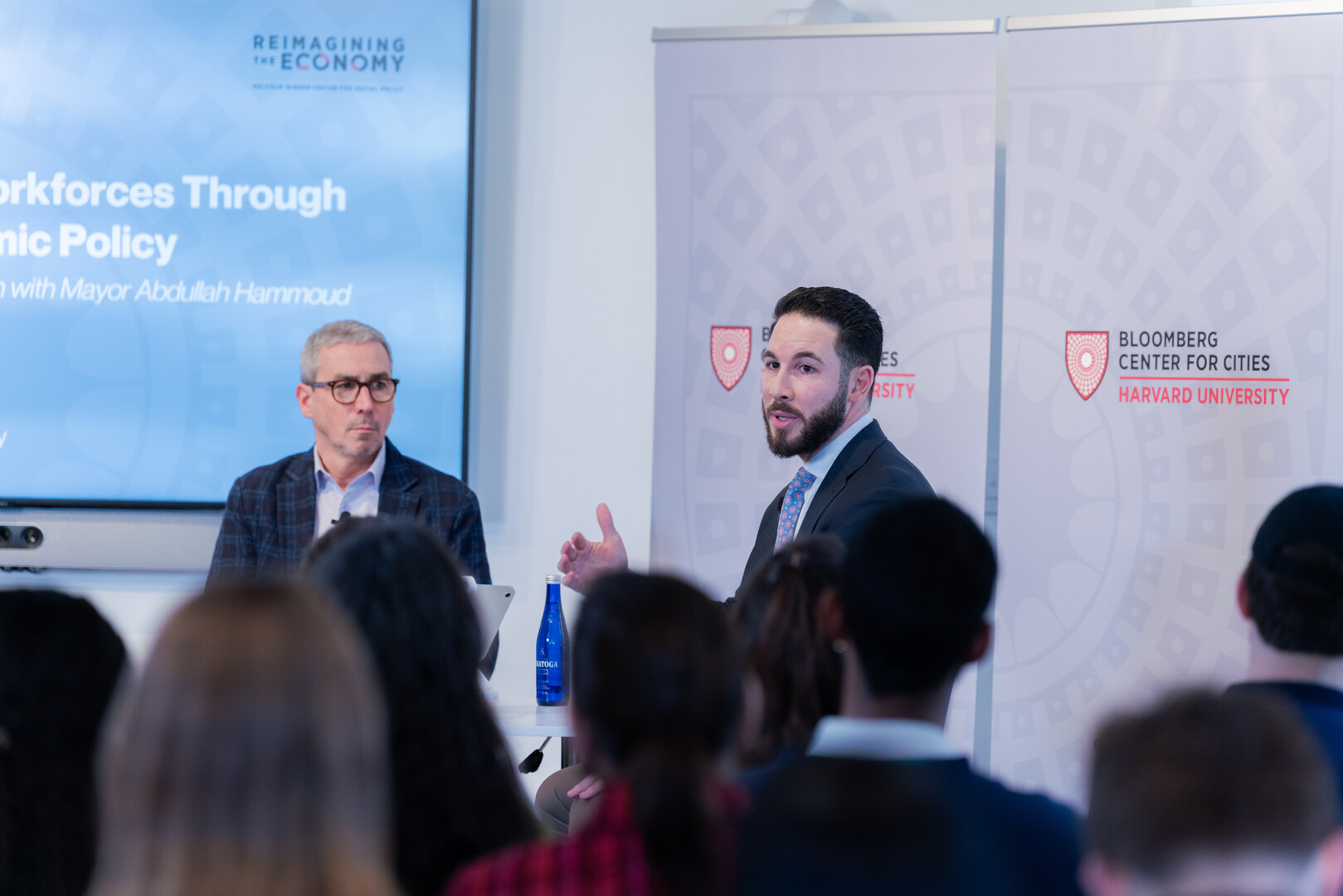
Cambridge, Massachusetts (February 23, 2026)— Dearborn, Michigan’s workforce strategy starts with a long view: Mayor Abdullah Hammoud is planning current and future opportunities in a city that’s getting younger while its economy is being reshaped by shifting industries and emerging technologies.
In a conversation with Harvard Kennedy School economist Gordon Hanson co-sponsored by the Bloomberg Center for Cities and the Reimagining the Economy project at the Malcolm Wiener Center for Social Policy, Hammoud described an approach that pairs convening power—bringing community colleges, employers, and unions into collaboration—with forward-looking funding and training policies. The goal? Expanding pathways into stable, high-paying careers for city residents. Hanson framed the stakes plainly: “Creating opportunities for job creation, for middle-skill workers and lower-skill workers is essential for our economic future, but also for the social fabric of our nation.”
Seeking to Build Resilience for Transitions
Workforce policy matters most at transition points, Hanson said: when young people are trying to enter the job market, when workers are displaced and need to switch industries, or when technology or life changes force mid-career pivots. In those moments, he warned, people can become stuck in low-wage employment. He went on to frame workforce development as career and technical education that builds skills, helps people identify careers, assists in job finding, and supports local workers as well as individuals who are probably not going to get a four-year college degree.
The Role of Community Colleges
Hanson said that community colleges are the primary providers of career and technical training because they’re deeply rooted in their communities. Proximity helps them understand local needs and maintain close ties with employers—an advantage, he said, when designing workforce programs that match local labor market needs.
Hammoud provided a local context: “Dearborn is a city of roughly 110,000 people,” he said. “Fifty percent of our residents are foreign-born…The fastest growing age group are actually those under the age of four.” He described a community where education is seen as a pathway to stability, but where city leaders also confront the reality that only about 80% of those who graduate high school go on to a four-year institution of higher education.
Dearborn built on an existing dual enrollment program with a more formalized “4 plus 1” early-college pathway that enables students to earn a high school diploma and an associate degree in five years at no cost. He framed it as a leadership choice to remove friction—cutting fees, simplifying admissions and credit transfer, and reducing bureaucratic hurdles—so more first-generation students can move quickly from affordable, useful schooling into promising career pathways.
A Structural Challenge
The conversation revealed a basic mismatch: demand for career and technical training rises when unemployment spikes, but the funding system often moves in the opposite direction. Because community colleges rely heavily on state and local support, and tuition covers only a small share of their budgets, their revenues can tighten just as more people seek training. For public sector leaders, Hanson said, that makes the design of funding formulas and budget rules a central part of building countercyclical workforce capacity.
Hanson said that local government-employer partnerships are widely praised but uneven in practice—some places build effective, ongoing collaboration with industry, while others have less success. When change is clearly needed, training systems can be slow to adapt, hanging on to programs after the local economy has moved on. That inertia, Hanson suggested, is reinforced by funding models that reward enrollment rather than outcomes, making it harder to retire outdated pathways and scale innovative approaches that respond to the economy’s demands.
Classroom Learnings Lead to Succes
Dearborn’s participation in the Bloomberg Harvard City Leadership Initiative’s Leading Economic Development in Cities program helped move local stakeholders to collaborative action. The program helps participants define and diagnose economic growth constraints, deepen personal leadership capabilities to drive change in their city halls, identify place-based opportunities for inclusive economic development, and take concrete steps toward a growth and inclusion strategy tailored to their city’s context.
Hammoud described a Dearborn partnership with Henry Ford Community College and Corewell Health that guarantees jobs for nursing graduates who pass licensing exams. That initiative covers 50% of tuition for early committers, creating a direct, results-driven pathway from training to employment. “When it came down to creating this guaranteed job opportunity,” Hammoud explained, “[the community college] had reached out to Corewell for two years unsuccessfully. We had the power of convening from the Bloomberg Harvard program and finally brought the stakeholders to the table to ink that contract.”
Audience questions homed in on the practical trade-offs leaders face: how to spur innovation in resource-strapped community colleges, how to build pathways that work for both large employers and smaller businesses, and how policy shifts—from federal higher-education rules to AI-driven disruption—change what cities should prioritize.
The discussion’s throughline was that workforce resilience isn’t just a menu of programs—it’s a leadership discipline. Hanson shed light on the realities of how the economy functions and how it challenges workers and policymakers. Hammoud’s examples from Dearborn highlighted what leadership looks like in response: simplifying pathways, convening employers and educators, keeping unions in the mix in a highly unionized local economy, and aligning budgets and partnerships to a long-term vision of resilience and accessible, high-quality jobs.
Key Takeaways
Resource: The Economy in Place
Explore data and insights on local labor markets across the U.S. from Economy in Place, an initiative of the Reimagining the Economy Project at the Malcolm Wiener Center for Social Policy, located at Harvard Kennedy School
Resource: Inclusive Growth in Cities
Learn to diagnose challenges and explore frameworks for data-informed and inclusive economic growth that works for your city.
Building Resilient Workforces Through Place-Based Economic Policy
Watch the recorded discussion.