
Harvard Alumni Highlight Pathways into City Leadership
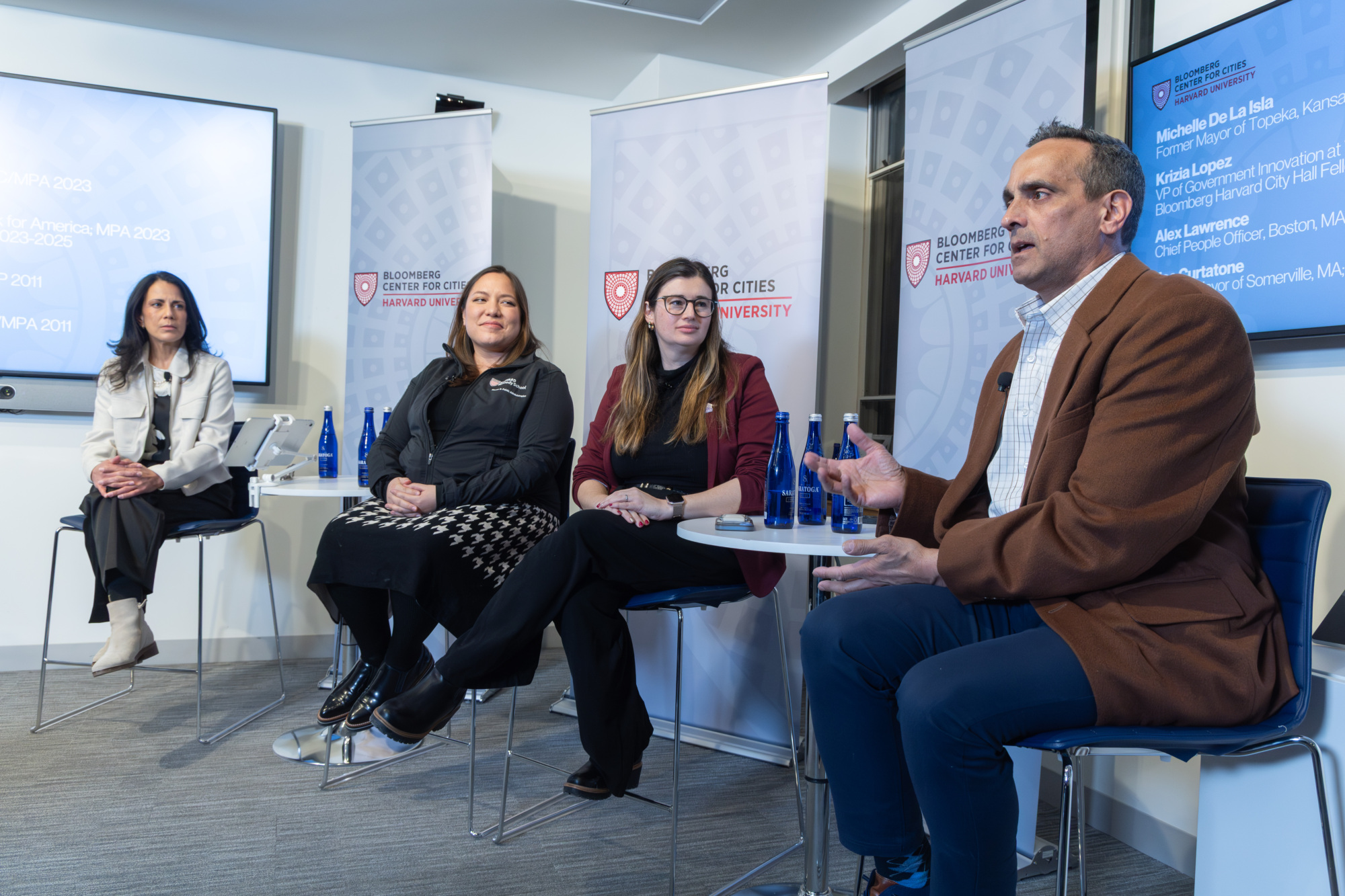
Cambridge, Massachusetts (February 12, 2026)— Harvard alumni and students gathered online and in person at the Bloomberg Center for Cities at Harvard University for a candid conversation about city leadership.
Co-sponsored with Harvard Kennedy School Alumni Relations, the Taubman Center for State and Local Government, HKS State and Local Alumni Association, and HKS New England Alumni Association, the event was designed for students and alumni considering a first step into public service or a mid-career transition, and for those who simply seek to gain perspectives on the many pathways into local leadership and impact.
The stakes in city work can be extraordinarily high, and the results can be quickly visible. As David Margalit, Executive Director of the Bloomberg Center for Cities, said in his welcome, it’s hard to imagine another job where “you can so tangibly see the impact of your work so often.”
Moderated by former Topeka, Kansas Mayor Michelle De La Isla, the panel featured former Somerville, Massachusetts Mayor Joe Curtatone, City of Boston Chief People Officer Alex Lawrence, and Work for America Vice President Krizia Lopez (a former Bloomberg Harvard City Hall Fellow in St. Louis). Each came to city work by a different route—through elections, fellowships, internal city hall experience, or a pivot from tech. Their stories described a workplace where the most consequential work isn’t always where outsiders expect to find it, “back office” systems can determine how essential services function, and crises become deeply personal because the people affected are your neighbors.
The Connection between Hiring and Service Delivery
One of the evening’s surprises was how frequently important outcomes hinge on fundamentals: hiring, process design, or operational capacity.
Lopez described arriving in St. Louis and finding a citywide hiring operation still largely running on “typewriters and mail and paper,” processing thousands of roles with clunky, outdated technology. With hiring timelines of nine months or longer, processing hurdles weren’t only an internal inconvenience. She recalled a period when people calling 911 with emergencies faced an eight-minute hold time due to staffing shortages, vividly illustrating how administrative systems can become public safety issues.
Over two years, she helped move the city to a digital platform and streamline the process, cutting hiring time by more than 50% for the 6000+ staff city—a gratifying result for Lopez personally and a big win for the city. The lesson wasn’t that every city can modernize overnight, but that in local government, improving the machinery of service delivery can quickly change what residents experience.
Routine Processes, Life-and-Death Consequences
In Lawrence’s experience in the city of Boston, many challenges labeled as technology or policy issues are, underneath, about people and process—how teams work, how decisions get made, and whether systems support the workforce responsible for delivering results.
Lawrence underscored that work some might dismiss as “back office” can carry life-and-death stakes. After two workers died in a trench collapse on a Boston worksite where there were extensive OSHA violations, she said, the city devised a new way to surface safety-relevant data from multiple sources during the permitting process. She reinforced a theme that ran through the panelists’ reflections: when you work in a city, the nuts and bolts of governing are not peripheral; how leaders take on those details can shape what happens in a community, with consequences that can be immediate and irreversible.
Benefits of Local Work
The panel described emotional benefits as well, describing the strong community relationships city leaders can foster. “There is no other form of government right now that still has the trust of their communities as cities do,” De La Isla said. “You don’t get that level of humanity in other levels of government.”
Curtatone reflected on the COVID-19 pandemic as a time that clarified what local leadership means in crisis. Much of his day was filled with detailed calls: who in his community was sick, who had died, who was losing a business, and who was at risk. Yet he also described the capacity cities can unlock by connecting municipal systems with local will. Community members and city teams together devised ways to feed people, deliver groceries, support learning, and check on the most vulnerable when no one had a playbook.
Lopez offered a parallel example from a tornado that struck St. Louis, redirecting much of the mayor’s office into emergency operations and months of disaster recovery coordination—an experience she described as “incredibly difficult” and “extremely rewarding.” Her takeaway was not only about urgency and collaboration, but about what crises reveal: city officials often have to build systems in motion, then capture what they learned so the next response is more resilient.
Audience questions broadened the picture of what city leadership demands in practice, especially around trust and organizational constraints. One attendee asked how a new city employee, especially someone new to the community, can enter the work hopeful about change if they are met with skepticism rooted in past broken promises. Panelists emphasized listening first, absorbing distrust with grace, and understanding why “glue-and-tape” systems exist before trying to change them. Lawrence cautioned against blaming flawed past decisions on people, noting that what looks irrational now may have been a reasonable choice given the information and constraints at an earlier time and that people may resist changes because they’re protecting fragile systems from collapse.
Delivering for Your Neighbors
The most surprising takeaway from the evening wasn’t that city work matters—it was how directly, and how broadly, it does.
The panelists described a level of leadership where the distance between decision and impact is often short; where organizational systems determine whether public services function well; and where serving constituents can be both operational and profoundly personal. Unlike some jobs that can feel abstracted from daily life, the panelists’ experiences in city hall leadership reflected immediate responsibility, relational opportunities, and rapid results that communities – neighbors – can see and feel.
-
Explore fellowships, research, resources, and experiential learning opportunities for the student community and future leaders at Harvard and beyond.
Pathways into City Leadership: Shaping the Future of Communities
Watch the recorded discussion.