
Building Pathways Out of Intergenerational Poverty in Cities
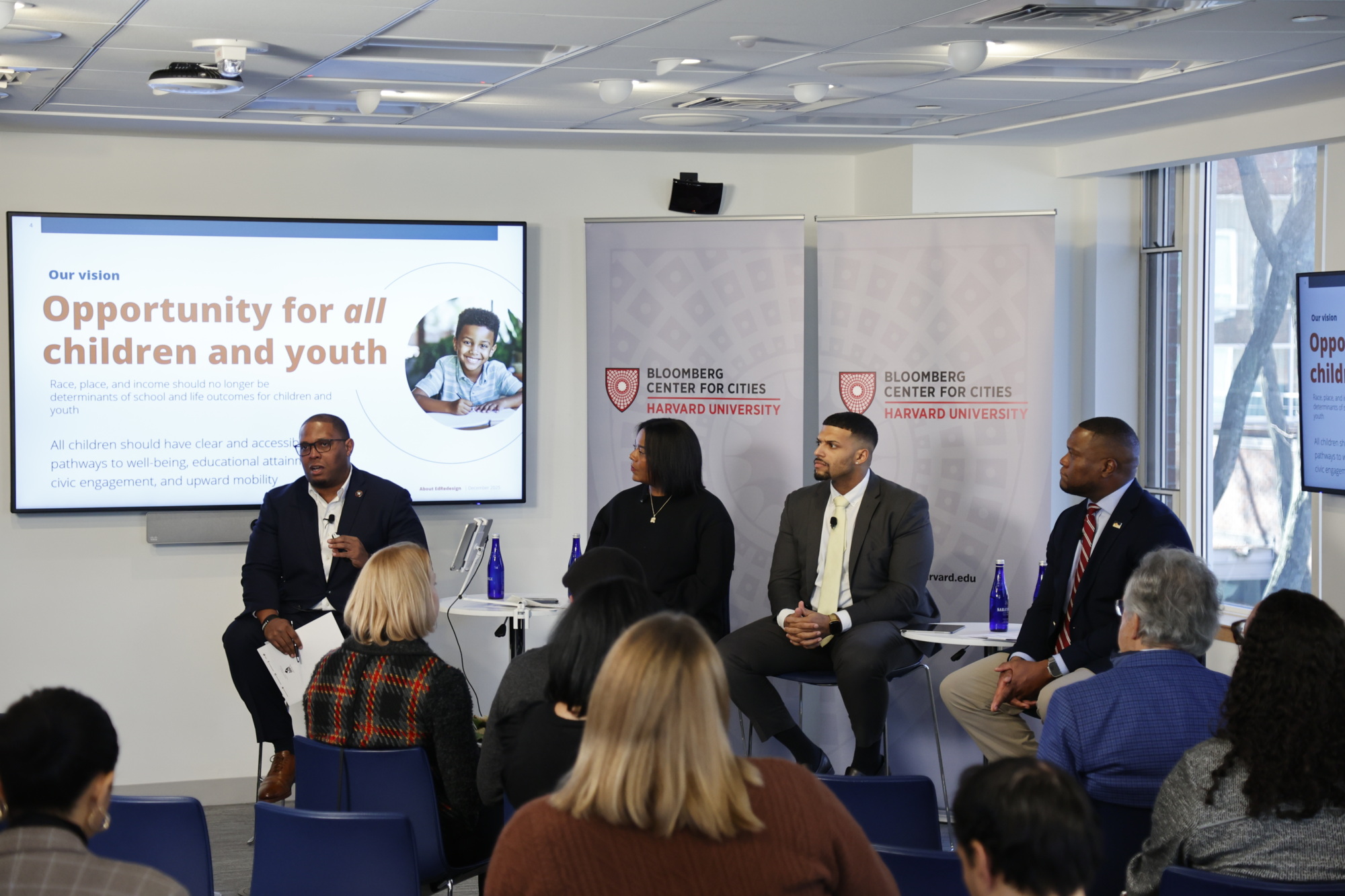
Cambridge, Massachusetts (December 17, 2025)—Cities across the U.S. are addressing the reality that opportunity is not evenly distributed for their residents. At a recent event co-hosted by the Bloomberg Center for Cities at Harvard University and The EdRedesign Lab led by Center faculty affiliate Rob Watson of the Harvard Graduate School of Education, leaders from Tulsa, Oklahoma, and Orlando, Florida, described how local governments are using cradle-to-career place-based strategies to disrupt intergenerational poverty within a single generation, expanding mobility for young people and families.
As moderator, Watson opened the conversation with a reminder of the urgent circumstances communities face, citing the country’s declining economic mobility. “Race, place, and income should no longer be determinants of who you get to be in life,” he said. Citing the country’s declining economic mobility, a research focus of Harvard economist and Center faculty affiliate Raj Chetty and his Opportunity Insights team, Watson framed the session to discuss ways cities can build supports “prenatal to career” to ensure every child has a viable pathway to upward mobility.
Turning Data into Action
For Tulsa Mayor Monroe Nichols, place-based data illuminated long-standing patterns. Early in his career, he noticed a kind of heat map, “five areas in Tulsa that popped up” with multiple challenges including youth involvement with juvenile systems, adverse public health outcomes, and unemployment. “We were all seeing the impacts,” he said, but leaders were not thinking about the stacking of problems in particular areas, and they were pursuing single-issue solutions in a variety of different systems.
Tulsa partners now use ImpactTulsa’s Child Equity Index to better understand why challenges cluster. Executive Director Ashley Harris Philippsen, an EdRedesign Cradle-to-Career Partnership Leader Fellow, noted that over a two-year period, “Over 3,500 students were evicted from their housing, and 72% of those students were chronically absent.” This reframed assumptions about causes of absenteeism: “It’s transportation, it’s housing, it’s safe routes to school, and it’s also health.”
Tulsa’s Children’s Cabinet, co-chaired by Philippsen and staffed in partnership with ImpactTulsa, is driving change with data like this, and aligning system leaders around the shared goal of putting 15,000 additional young people on a path to economic mobility.
Two Decades of Place-Based Investment in Orlando
Orlando’s approach began nearly twenty years ago in the Parramore neighborhood and has since expanded citywide. Abraham (Abe) Morris, the city’s Children, Youth, and Families Division Manager, outlined long-term drops in crisis statistics following the city’s focused work, with child neglect and abuse reduced by 68%, juvenile arrests down 81%, and teen pregnancies lowered by 46% from 2006 to 2024. Shootings were down 47%, gunshot wounds reduced by 34%, and 26% fewer homicides occurred from 2022 to 2024 compared to the two previous years. Morris noted that 98% of young people served by student advocates graduated from high school in 2024.
These gains required sustained investment. “If you don’t do anything, there’s an investment in that as well,” Morris said, underscoring that the costs of inaction are both financial and human.
Building Relationships of Support and Redirection
Morris highlighted the crucial role of relationships to help redirect young people at risk. He shared the story of a young man whose challenges began early—birth to a teen mother and a father incarcerated for murder, housing instability and all-but-abandonment by the adults in his life, serial school suspensions, a gun charge in ninth grade, and the death of a close friend before his eyes. Yet he didn’t receive services until the age of 22. Today, through Orlando’s individualized supports, he is working and moving forward. For Morris, such stories reinforce a core belief: “We are just one generation away from breaking generational poverty.”
Nichols emphasized that data gives partners clearer roles and shared accountability. ImpactTulsa’s analyses, he said, provide “the translation across systems to help us better contextualize what is the individual role of my institution, and then what is the collective thing that we’re all working toward.”
Collaboration as Civic Infrastructure
Throughout the event, panelists stressed that cross-sector collaboration must be intentionally designed. Nichols described Tulsa’s approach to governance as rooted in “clarity, consistency, and accountability.” Harris Philippsen highlighted backbone coordination that helps partners align programs, policy, and funding toward common outcomes.
Both cities center youth voice. Tulsa includes young people across its working groups and cabinet, and Orlando teens successfully advocated for expanded access at a city-run teen center.
A New Discipline in the Making
Watson described this work as an emergent field—one that brings together education, housing, public health, neighborhood development, and human services to address the broader forces shaping opportunity.
Nichols offered a closing charge to city leaders nationwide: “Commit to doing this work, it’s critical…there’s enough body of evidence that you’ll know how to start to engage, even if you have to feel your way through it.” He pointed out that the work crosses political lines because of its strong positive results, showing clear return on investment and high impact in bettering people’s lives and communities.
The successes in Tulsa and Orlando show that when cities align data, partnerships, and human relationships, they can convert metrics into momentum—and build pathways that change outcomes for young city residents in a single generation.