
Solving Problems Together: A Discussion of People, Power, and Change
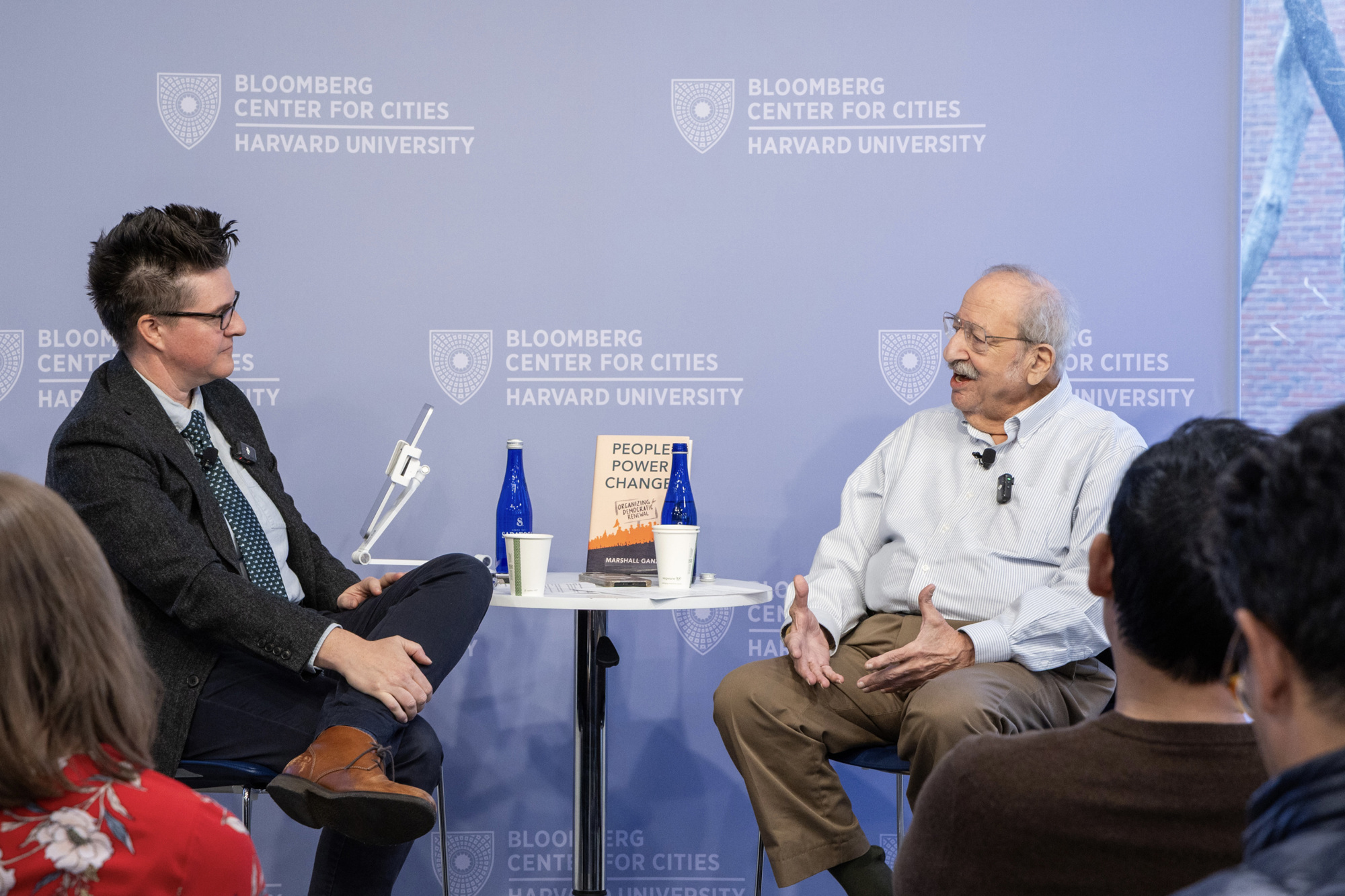
Cambridge, Massachusetts (December 2, 2025)—When Harvard Kennedy School faculty members Marshall Ganz and Erica Chenoweth took the stage at the Bloomberg Center for Cities, their focus was not political polarization or movement strategy. It was something more foundational: how people come together most effectively to take on tough challenges.
“When people organize through relationships, they gain the power to solve problems together,” Ganz, the Rita E. Hauser Senior Lecturer in Leadership, Organizing, and Civil Society, said. That idea anchored a conversation that felt both personal and urgent, conveying principles of organizing that Ganz has practiced and taught for many years – including to mayors from around the world.
What Motivates Collective Action
Chenoweth, the Frank Stanton Professor of the First Amendment and Director of the Nonviolent Action Lab at the Ash Center for Democratic Governance and Innovation, conducts research to quantify the success of nonviolent and violent campaigns. “Every time Marshall and I sit down together,” Chenoweth said, “We realize it’s such a rich conversation, and we should have either recorded it or done it in front of people—and now we’re doing both.”
Bloomberg Center for Cities Director Jorrit de Jong introduced the discussion, noting that Ganz teaches the practices of public narrative to mayors as part of the Bloomberg Harvard City Leadership Initiative. An Action Insights summary of Ganz’s research explores why some words move people to action while others are quickly forgotten, using the example of Pete Buttigieg’s mayoral leadership in South Bend, Indiana and explaining the power of drawing on shared values to motivate people to take collective action.
Understanding Drawn from Experience
Asked what drove him to write his 2024 book, People, Power, Change: Organizing for Democratic Renewal, Ganz began with a story of Mississippi in the mid-1960s, where he first encountered the courage of young people confronting structural and systematic racial injustice during the civil rights movement. He discovered that organizing meant drawing out people’s own capacity rather than delivering answers from outside. That early lesson—that change begins with the power generated from relationships—formed the backbone of his work.
Ganz raised thought-provoking questions. “If you need what I’ve got more than I need what you’ve got, who’s got the power?” he asked the crowd. Power, he argued, is “an influence created through interdependence,” something generated between people rather than accumulated by individuals.
His story of the Montgomery bus boycott, the yearlong community protest that succeeded in challenging bus segregation, drove the point home: “It turned out everybody had feet.” Those feet led Montgomery, Alabama’s Black residents to walk rather than give their fares to city transit, and to meetings at the community’s churches where they organized carpools and other supports to keep the boycott going. Starting with existing strengths, even when modest, is central to motivating collective action.
Reflecting on his recent book tour, Ganz said he was struck by “the hunger out there”—people eager to act to bring about change, but too often treated as abstractions. “We become text messages. We become data points,” he said, critiquing political practices that mistake polling for listening.
Chenoweth added another example: activist James Lawson’s year of one-on-one visits in Nashville, listening to residents’ concerns before any tactic was chosen to fight inequities. That kind of relational groundwork, they noted, made the Nashville movement’s success possible: “You can’t just go in and say, they’re doing this tactic in this town, we’re going to do it here and get the same outcome.”
Leadership as Enabling Others
Ganz drew a line between authority and leadership. “Leadership is accepting responsibility for enabling others to achieve shared purpose under conditions of uncertainty,” he said—a definition he returns to often in his teaching. Chenoweth pressed him on how elected leaders can maintain real relationships with organized constituencies, especially after campaigns end. Ganz emphasized that sustaining relationships—rather than reverting to top-down authority—is both rare and essential.
Participants asked a range of questions on topics ranging from rebuilding trust after political crisis to navigating misinformation. In his responses, Ganz underscored the fundamentals of the work: relationship-building, commitment, and the courage to take collective risks. Democratic renewal, he suggested, will not come from waiting for institutions to fix themselves. It will come from people choosing connection, agency, and shared purpose.
Guide: Public Narrative in Practice
Download Marshall Ganz’s pedagogical guide to leadership through storytelling.
Organizing People through Storytelling: Public Narrative as a Leadership Development Practice
Why do some words move people to action while others are quickly forgotten? Read Action Insights from the research.
People, Power, Change: Marshall Ganz in Conversation with Erica Chenoweth
Watch the recorded discussion.